Showing posts with label oscar nominated. Show all posts

Tuesday, January 14, 2020

Bombshell (2019) film review

Year: 2019
Running Time: 109 minutes
Director: Jay Roach
Writer: Charles Randolph
Cast: Charlize Theron, Nicole Kidman, Margot Robbie, John Lithgow, Kate McKinnon, Connie Britton, Allison Janney, Malcolm McDowell, Josh Lawson, Ben Lawson, Liv Hewson

Bombshell opens in cinemas around the country on January 16, 2019 thanks to Studiocanal.

Jay Roach's Bombshell is the award season movie that is far from flawless, but the emotional punch it delivers and extraordinary performances by the leading ladies are enough to make one overlook it's sins. It is a film that feels as though it has been sugar-coated visually, but at the same time balances itself out with hard-hitting topics that will trigger many. The scandal at Fox News involving Roger Ailes is shocking by nature and the film could easily have relied just on the story for impact, but Bombshell ventures to be more than a film based on a shocking story and manages to get it right more often than not.

In what is a very left wing film about the infamous right wing television network, Bombshell is a film that will stir up confusing emotions in many people. Earlier last year the Showtime mini-series, The Loudest Voice chronicled the life of the larger than life founder of Fox News, Roger Ailes. The show earned incredible critical acclaim with Russell Crowe winning the Golden Globe for playing Ailes and indeed looked at the sexual harassment claims made against him, which were led by Fox and Friends co-host, Gretchen Carlson (portrayed here by Naomi Watts). Unlike the television series, Bombshell is a film about sexual harassment in the workplace with a focus on the women affected.

For those of us who are already angry at Fox News on close to a daily basis, Bombshell will do a great deal to encourage that anger. The film goes as far as to say that even people who work for the network are only there because no one else would hire them after they work for Fox. The Fox News painted here is an evil workplace that strives on scandal, both on air and off. The women are all instructed to wear as short skirts as possible when on air and are expected to laugh along while their male co-hosts make jokes (often sexist) at their expense. As we see at the beginning of the film, this also includes the then Republican Presidential candidate, Donald Trump, accusing then Fox darling, Megyn Kelly (incredibly portrayed by Charlize Theron) of "anger-menstruating". She is instructed not to retaliate, as it would not benefit the network's relationship with the Republican party. The overall negative view we get here of Fox News is extremely one-sided, but is also shrouded in truth.


The 2016 scandal involving Ailes was one of the first reported high-profile cases of ongoing sexual harassment in an entertainment based workplace. It is nothing short of horrific the rippling effect that these incidents had on the culture of the workplace and the individuals themselves. Bombshell brings to the forefront many of the toxic features of an environment where these events are taking place. It is shocking to see how these events are not only turned a blind eye to, but that they are also accepted as part of the culture and even quietly supported by other women who want to please their male superiors.

One of the questions that is often asked when people come forward with their stories of sexual harassment in the workplace is why they did not report it when it happened, and Bombshell certainly does not shy away from the answer to this question. Gretchen Carlson (played by Nicole Kidman) begins her journey to expose Ailes (John Lithgow) by herself, with the hope that others will come forward with their claims to support hers. Inside Fox, there are sharp whispers of women coming forward and the women in question are pounced upon with quiet threats of trouble if they do not support their boss. There is much to be scared of including loss of promotions, ostracization and even loss of their position in the company. The road to peace from sexual harassment is not a straight or smooth one by any means, as is demonstrated here. The emotional impact on the victims is also a very hard watch in this film. Margot Robbie plays Kayla Popisil (a young women who has grown up in a family who watch Fox News religiously), who is the subject to Ailes unwanted advances when she expresses her desire to progress further with Fox. Her portrayal of a victim of sexual harassment is harrowing and powerful, and shows how such an event can change a person and their view of the world.

Bombshell is first and foremost a film about sexual harassment in the workplace and second of all a film about the Fox network. Viewers of Fox will also be angered by the film, but not in the same way as those who are not fans of the network. Again, Bombshell does not paint the Fox environment or personalities in a good light, but one cannot deny that the characters are expertly cast and played. Charlize Theron completely disappears into her character of Megyn Kelly, and credit must be given to the hair and make-up department for making her look so incredibly similar to Kelly. However, it is not just the visuals that make Theron into Kelly. She completely personifies her in voice and mannerisms, as well as turning in a perfect amount of emotion and strength. Nicole Kidman also is terrific as Gretchen Carlson, a personality she already physically resembles and does not rest on this as the driving nature of her performance.


The downfall of Bombshell is that it tends to hover in between a Saturday Night Live episode and The Big Short. Roach employs several of the film-making techniques that Adam McKay used in his 2015 film, but with nowhere near as much ease and success. The editing of the film is irritatingly choppy throughout and several scenes could have been done without. It is a film which is rich in pop culture, which given the opportunity here means it can be a bit of fun and is given a bit of a glamorous exterior, meaning lots of beautiful women in beautiful clothes. These features almost fly under the raider, which is a good thing as there should be nothing fun about a film about sexual harassment.

The unfortunate truth about Bombshell is that considering it is a film about the victims of sexual harassment in the work place, it would have benefited from having a female director. Roach does a very good job with the film, but as this is a film about women, there was the opportunity to have had someone at the helm who could bring even more sympathy and perhaps even experience to the film. Nevertheless, Bombshell does captures the seriousness of the issue of sexual harassment in the workplace and through it's incredible performances, stirs emotions within you that make it hard to forget.

7/10

Wednesday, February 24, 2016

Brooklyn (2015) film review

Year: 2015
Running Time: 111 minutes
Director: John Crowley
Writers: Colm Toibin (novel), Nick Hornby (screenplay)
Cast: Saoirse Ronan, Emory Cohen, Domhnall Gleeson, Jim Broadbent, Fiona Glascott, Julie Walters, Eileen O'Higgins, Jessica Pare, Emily Bett Rickards, Eve Macklin, Nora-Jane Noone

Brooklyn is now showing in cinemas everywhere and is distributed in Australia by Transmission Films and in the United States by Fox Searchlight.

With it's glorious sense of 1950's nostalgia, it is almost surprising how relatable the story and themes in John Crowley's Brooklyn are to the modern woman in it's heart-warming story of personal growth and love.

In the early 1950's, young Irish girl, Eilis (Saoirse Ronan) is sent to America to make a new life for herself in Brooklyn, New York. Plagued by an over-whelming sense of homesickness, the beginning of her journey is not a happy one. However, things soon turn around for Eilis when she finds a sense of purpose studying bookkeeping at night and meets Tony (Emory Cohen). She and Tony find love in one another and start to plan for a future together, until Eilis receives the terrible news that her beloved older sister, Rose (Fiona Glascott) has passed away suddenly. She returns to Ireland to console her mother and is faced with the dilemma of whether she should stay in her homeland with her mother or return to Brooklyn to her new life and Tony.

Brooklyn is a simple, but incredibly sweet and beautiful film. It's beauty lies in both the exquisite mode of storytelling by screenwriter, Nick Hornby and in the delightfully unique visuals of 1950's Brooklyn. The story of Eilis is uncomplicated and straightforward, but it's charming nature makes it mesmerising and enjoyable. While Brooklyn seems to primarily be encouraging one to follow their heart, it possesses a greater depth than it's face value. It shines a light on the idea of doing something because it is what you know what is right for you rather than what everybody else believes you should do. Following one's heart is easy when you have support from those around you, but it is much harder to do when what everyone else believes what thy think is right for you contradicts your beliefs. Eilis experiences an internal struggle on return to Ireland when she starts to once again feel as though she is part of the town, but she soon realises how trapped she feels by everyone else's assumptions about her future.


Despite it being set over half a century ago, the idea of a young girl leaving home and travelling overseas by herself is a rather modern one. While in this day and age a plane would transport one across the seas instead of an ocean liner, many young people (both men and women) embrace the idea of leaving home and living a year abroad. The emotions one goes through upon arrival in a brand new country are very similar to Eilis. It is not unusual to feel an initial overwhelming sense of homesickness before finding your feet and embracing a new life with new opportunities which would not be found in one's homeland. A solo trip abroad can also make one more independent and also more confidant within oneself, which seen here with Eilis in Brooklyn. This, along with it's theme of self-fulfilment, makes Brooklyn incredibly relatable despite the time in which the film was set.

Brooklyn is an incredibly attractive production with it's superb cinematography and phenomenal costume design. The location shots of both Ireland and New York are contradictory in nature, but they are both beautiful in different ways which allows one to understand Eilis' dilemma It is the exquisite costume design by Odile Dicks-Mireaux and complimenting hair and make-up that gives the film a true nostalgic and rather sweet and adorable edge. The costumes are absolutely beautiful, particularly the New York characters' wardrobes. Their clothes come to represent who each character is, where they come from and also change as the character develops.

Saoirse Ronan is the perfect fit for Eilis. Ronan herself was born in New York City to Irish parents who moved back to Ireland when she was very young. She brings a sincerity to the role that makes one feel immediately engaged and emotionally invested in her character. Ronan truly does carry the film as she is in almost every scene and is at all times engaging as the sole focus. She is fiercely real as the timid, homesick girl from Ireland and completely believable in her character growth and development. Emory Cohen is also a stand out. Like Ronan, he brings a real sincerity to his role as  Eilis' Italian boyfriend, Tony and the joy of his love for Eilis is both incredibly sweet and infectious.

Brooklyn is a truly exquisite piece of cinema. It is an absolute joy to behold with it's engaging tale of love and self-discovery and it's visual beauty.

9/10


Monday, February 8, 2016

Spotlight (2015) film review


Year: 2015
Running Time: 128 minutes
Director: Tom McCarthy
Writers: Josh Singer and Tom McCarthy
Cast: Michael Keaton, Mark Ruffalo, Rachel McAdams, John Slattery, Liev Schreiber, Brian d'arcy James, Stanley Tucci, Billy Crudup, Gene Amoroso, Jamey Sheridan, Neal Huff

Spotlight is now showing in Australian cinemas and is distributed by eOne.

Absolutely engrossing and the stunning example of story driven tension, Spotlight is a superb film with an incredible screenplay that brings to light terrible issues while not actually telling a story about them.

In 2001, members of The Boston Globe's Spotlight team were given the assignment of looking into allegations of child molestation by Catholic priests within the city and determining whether there was any evidence of a pattern among them. What they discovered over the year that they spent investigating and speaking to the victims was sufficient evidence of a cover up within the church on a much greater scale than they or anybody else could have ever imagined.

Spotlight is ultimately not a film about the actions of the Catholic Church and it's priests, although it will no doubt stimulate thought and conversation about the subject. It is a film about the journalists who were part of the Spotlight team and how they came to expose the cover up. So at it's core, Spotlight is essentially about investigative journalism and how it has the power to increase knowledge and awareness and bring about change.

Tom McCarthy's film is in the same class as All The Presidents Men, the 1976 film about the reporters who uncovered the Watergate scandal. Like All The Presidents Men, Spotlight will become a film for all journalists and journalism students to watch as it is not only an example of extremely good investigative reporting, but it is also what all journalists strive for, which is to put the pieces together and uncover something that nobody else has. Of course All The Presidents Men and Spotlight are extreme and very rare examples of what journalists can achieve, yet they remain inspiring for those who are in the profession.

The power of investigative journalism is at the heart of Spotlight, but again the actions of the Catholic Church are brought to light in the process. It is impossible not to be moved by the revelations that the Spotlight team make over the course of their investigation, but the wonderful thing is that it is not the witnessing of these atrocious acts that bring about emotion. It is all in the dialogue spoken by those who uncover the shocking information and by the victims telling their stories. There are no confronting visuals of the actual acts of molestation in the film. This may be comforting to some, but the truth is that the imagination can conjure up mental images that are just as frightening.


This is what makes Spotlight such a brilliant piece of work. It is not a film with a great deal of action, but it is it's story and dialogue that are so powerful that they create emotion, tension and suspense by themselves. The outcome of the investigation is inevitable, yet there is still a build up with a sense of heightened tension leading towards the conclusion.

While the film's strength lies in it's screenplay, it's visuals help support the story and say the things which aren't being verbalised. The investigation by the Spotlight team takes place over the course of a year and this time period is shown with the cinematography involving the changing of seasons. Visually, the film is very neat and refined. One particularly special moment of the film is at Christmas time, when all the main characters are shown in a montage that expresses how they are feeling accompanied by the sounds of children singing a Christmas carol. It is a rather haunting moment.

Spotlight is essentially about the team of journalists who uncovered something truly incredible and were awarded the Pulitzer Prize for their work. However, the film does not glorify the individuals or make them out to be heroes. They were just people going to work each day and doing their jobs. Despite this, the cast of Spotlight all give strong and memorable performances. Mark Ruffalo gives the most passionate performance as Mike Rezendes. His character's commitment demonstrates how the deeper into the investigation he got, the harder it was to not get emotionally involved. Michael Keaton stars as the head of Spotlight, Walter Robinson and gives a strong performance, but it is not one that requires much emotion or variation.

As Sacha Pfeiffer, Rachel McAdams gives the best performance of her career thus far. Her character develops the most throughout the film as she is the one who had the greatest connection to the church beforehand and her internal struggle while she sympathizes with the victims is rather moving. Stanley Tucci gives a very interesting performance as Mitchell Garabedian and although he is rather hostile, is intriguing to watch and has a great deal of character.

Spotlight demonstrates not only the power of investigative reporting when all the pieces come together, but how suspense and emotion can be achieved by superb storytelling and direction.

9/10


Thursday, February 4, 2016

Steve Jobs (2015) film review

 
Year: 2015
Running Time: 122 minutes
Director: Danny Boyle
Writer: Walter Isaacson (book), Aaron Sorkin (screenplay)
Cast: Michael Fassbender, Kate Winslet, Seth Rogan, Jeff Daniels, Michael Stuhlberg, Katherine Waterston, Sarah Snook, Makenzie Moss, Ripley Sobo, Perla Haney-Jardine
 
Steve Jobs was released in Australian cinemas on February 4 and is distributed by Universal Pictures.
 
Danny Boyle's Steve Jobs breathes new life into the much told life story of the technological pioneer with his eclectic direction of Aaron Sorkin's crisp and creative screenplay setting this film apart from those that have come before it.
 
There has been much written about the man who is considered by many to have been the genius behind our current age of technology with such achievements to his name as co-founder and CEO of Apple and the development of innovative products including the iMac, iPod and iPhone. With over a dozen films to date which feature Jobs  (including features and documentaries), this 2015 feature film brings with it a point of difference with it's mode of storytelling that makes it anything but a straight-forward biopic.
 
Steve Jobs is a film sliced into three by what are seen as three of the most important and pivotal nights of Jobs' career. These nights are the launch of the Apple Macintosh (1984), the NeXT computer (1988) and the iMac computer (1998). During each of these moments in time, Jobs (as portrayed by Michael Fassbender) is faced with not only the pressures of ensuring that his presentations achieve the desired outcome for his products, but the pressures imposed on him by the people who have had a great impact on both his professional and personal life.
 
The mode of storytelling adapted in Steve Jobs is indeed intriguing and this is what sets it apart from other films which aim to document the life of Jobs. Unlike others, this film only focuses on a 14 year period of his life with references to his earlier life to explain his character. As one has come to expect from an Aaron Sorkin screenplay, Steve Jobs is extremely dialogue driven and incredibly witty. From the opening moments of the film, the delivery of the stunning dialogue by Michael Fassbender as Jobs, Kate Winslet as Joanna Hoffman and Michael Stuhlberg as Andy Hertzfeld is enthralling and thoroughly entertaining.


However, the fact that this film is so dialogue driven and not so much action driven may not be enjoyable to some as it will not feel as though much happens and that there is no real suspense or ongoing tension. This is also a result of the film being divided into three segments, as it is not traditional storytelling and therefore there is not one singular climactic moment of conflict and resolution.
 
Another example of how Danny Boyle's film is not like its predecessors is that it is not a reliable point of reference for the life of Steve Jobs, but it does not seek to be so. Steve Jobs is a film representing the life of Steve Jobs rather than documenting it. In other words, the events and discussions which take place are only based on reality. For example, Jobs and Steve Wozniak were indeed at odds with each other, but they did not have a public confrontation the way it was depicted in the film. In fact, there isn't a great deal in Steve Jobs that occurs the way it did in reality and the majority of scenarios are fictitious. Not only this, but there are many important aspects of Jobs' life omitted from the film. In the name of cinematic art, one can understand why Sorkin chose to pen this story of Steve Jobs the way he did. It is an interesting and entertaining portrait of a complicated and intriguing human being told in a creative way and using exquisite cinematography to enhance it. However, it should not be used as a point of reference for Jobs' life and Jobs aficionados will be unimpressed.
 
The depiction of Steve Jobs in Boyle's film has come under fire from those who knew him as they believe it is not a favourable representation of the man. However, Michael Fassbender's performance is wonderful. His Steve Jobs is a strong character who is able to control and command every scene in the film. His character is one who is not always likable and not overly glorified, which is always a challenge in biopics and a welcomed change.
 
Fassbender is supported by a cast who all give fine performances. Kate Winslet plays Jobs' right hand woman, Joanne Hoffman who stands by him throughout his trials and tribulations and she is his voice of reason. Winslet gives an exceptionally strong performance and the chemistry between her and Fassbender is wonderful. Michael Stuhlberg and Jeff Daniels both give solid performances and Katherine Waterston is very good as the mother of Jobs' child.
 
Steve Jobs defies the rules of the biopic by way of it's unique and commendable method of storytelling. There is great appreciation to be felt for the stunning dialogue written by Aaron Sorkin and the wonderful deliverance of it by the cast.
 
7.5/10


Monday, February 1, 2016

Carol (2015) film review


Year: 2015
Running Time: 118 minutes
Director: Todd Haynes
Writers: Patricia Highsmith (based on the novel "The Price of Salt"/ renamed "Carol" by), Phyllis Nagy (screenplay)
Cast: Cate Blanchett, Rooney Mara, Sarah Paulson, Kyle Chandler, Jake Lacy, John Magaro

Carol is now showing in Australian cinemas and is distributed by Transmission Films. Now showing in the United States and distributed by The Weinstein Company.

"I'm charting the correlation between what the characters say and how they really feel"

This early piece of dialogue said by the film loving character of Dannie (as portrayed by John Magaro) is a wonderful interpretation of Todd Haynes' Carol which is written into it's screenplay by Phyllis Nagy. It is not so much in what the characters say as what they show that is the heart of the this deep, beautiful and visually stunning film. The portrayals of these extraordinary and memorable characters by Cate Blanchett and Rooney Mara ensure that Carol is not just a film about forbidden love, but a story of self discovery and acceptance through our relationships with others and chance encounters.

1950's New York City: Therese Belivet (Rooney Mara) lives a life that may seem fine from the outside, but she is left unfulfilled by her job at a department store when she aspires to be a photographer and also within her relationship with her boyfriend, Richard (Jake Lacy) who very much wants to make Therese his wife. A chance encounter with the older and more sophisticated Carol Aird (Cate Blanchett) takes Therese's life in a different direction as she and Carol begin a close friendship which turns into something far deeper and emotional. The two travel on an idyllic road trip together, which comes to an abrupt halt when Carol receives word that her husband (Kyle Chandler) plans to use information about her and Therese against her in a court action that will result in her being denied a relationship with her beloved daughter.

Carol is not just a story of a love affair between two women, it is a story about a twist of fate or simple event that see's your life take on new meaning and direction. In this film, it is the simple glance between Carol and Therese before they meet that symbolises the changing of Therese's life and the start of her leaving behind her unsettled and awkward self to understand who she really is. It is also an incredibly nostalgic experience, both visually and by way of the mentality of the times. While the love between two people of the same sex is very much accepted in today's society, the 1950's were much less accepting and unforgiving. It can be quite distressing to see the way in which the character of Carol is treated by her husband and family and how she is not considered to be a fit mother by way of her sexual orientation, as well as the methods they employ to try and change her. This does seem distressing by today's standards, but it is an imprint of the way society thought in the 1950's and what was deemed acceptable.


However, the nostalgia of the film is far more attractive in it's stunning visuals. The recreation of mid-century New York City is wonderful and incredibly atmospheric. The costume design by the acclaimed Sandy Powell is absolutely exquisite. The costumes are not only a fine representation of the time period, but they also are very character specific and, as is the case with Therese, they change to represent the development and change of character throughout the film. The cinematography by Edward Lachman is equally intriguing and works to give the film it's nostalgic edge along with it's wonderful use of colour. Lachman frames the main characters in certain shots in such a way that makes sure one is not distracted by anything that is not relevant to subject at hand.

The result of the marriage between Todd Haynes' direction of his two leading ladies and Phyllis Nagy's screenplay is phenomenal. Throughout the film there are some absolutely superb and memorable lines of dialogue which are relatable even if one is not in the same situations as the characters. One particularly beautiful quote from Rooney Mara's Therese is "I don't know what I want. How could I know what I want if I say yes to everything?"

Even though Carol is set in the 1950's, it is considered a modern idea to say yes to everything and have this open you up to a world of opportunity. Yet, Therese verbalises here that saying no is just as important as saying yes, as saying yes too many times does not distinguish your character or shape you as a person. The exquisite dialogue is not only accompanied by, but strongly supported by the simple actions of the characters that are not exaggerated, but speak louder about what the characters are feeling than words. A brief glance or a touch of the hand that does not linger says a great deal more about what they are feeling than their words say, but works together with what they do say to create greater emotion and understanding.


Both Cate Blanchett and Rooney Mara give incredible performances which are worthy of their Academy Award nominations. Blanchett's performance is intriguing as the older woman who displays the strong characteristics one would associate with the more powerful and experienced half of a couple. Yet she is also a very fragile woman who, as one finds out as the film goes on, is not as emotionally strong as she appears to be.

Even though Blanchett portrays the title character, Carol is just as much Rooney Mara's film. Mara shines as the young Therese who is unsure of her place in the world until she meets Carol. She has a pixie-like quality which makes her incredibly endearing and likable. She is a character many will see themselves in a she is trying to fit into what she believes society would have her be, but is destined to live a more meaningful existence.

On the surface, Carol is a beautiful film with it's nostalgic images and classy cinematography. Yet underneath it is just as beautiful with it's relatable themes that accompany an already deeply emotional story.

8.5/10

Sunday, March 10, 2013

Life Of Pi (2012)

Year: 2012
Director: Ang Lee
Cast: Suraj Sharma, Irrfan Khan, Rafe Spall, Gerard Depardieu

Before I begin my review….
                I didn’t get to review Life Of Pi as part of my Oscars lead up, but better late than never!

                I read the novel, Life Of Pi by Yenn Martel at the beginning of 2012. I thought it was a brilliant book with absolutely beautiful use of language. However, I knew this film was in production and was to be released later in the year. This troubled me because the whole way through the book I was thinking to myself  ”How are they going to be able to make this in a movie?”

                It looked like it was going to be one of those films when it was released, people would say “They should have just left the book as it was and never made a movie out of it”.

                That is, until I heard Ang Lee would be the director.

                There is no denying that Lee is an amazing director. He was the perfect person for the job. Did he deserve his Oscar for direction for Life of Pi? I believe so. You know why? Because he took a novel that many people including myself thought could never be made into a film because of the reason that it was the language used that made the book so amazing and also because there are large periods of the book where not much happens, and made it into a well above average film. Granted, yes there are still parts in the film that not much happens, but these moments give you the most amazing visual moments of the year in film. Lee made some amazing choices for his film. Choices which won him the Oscar.

                Well done Ang Lee!

Review
                There is no denying it, Life of Pi was the most visually beautiful film of 2012.

                Ang Lee’s latest achievement shows us how far film has come in regards to cinematography and visual effects. When you think of incredible visual effects, an action film of sorts is normally the genre you think of. However, Life of Pi is far from that and uses what is available to us in the film these days to its utmost potential. It’s beauty is awe inspiring.

                Pi Patel (Suraj Sharma) grew up in a zoo in India with his parents and older brother. His parents make the decision to Canada in order to start a new life and set off for their new life on a Japanese cargo ship with all their animals. However, the boat hits a violent storm and the boat sinks leaving only Pi and an orang-utan, zebra, hyena and Richard Parker, the zoo’s Bengal tiger alive. As Richard Parker uses the animals as food, Pi learns survival techniques like no other to stay alive stranded in the middle of the ocean with a hungry Bengal tiger.

                It was always going to be a hard task to adapt Life of Pi from book to screen. Large parts of the novel by Yenn Martel involved Pi’s thoughts as he sat on the boat, which were always going to be hard to bring to the screen. The length in which Pi was on the boat was also going to be hard to bring to the screen without it becoming overly boring for members of the audience. The screenplay does lack in parts due to these potential problems, as Pi’s time on the boat does feel a tad tedious. However, the whole point of the film is about a man on a boat so it is important that you feel the stretch of time which Pi is on the boat.

                It is the visuals that make this film so incredible. There are so many moments which make the film an absolute visual delight. The visuals chosen for the scenes in which Pi is telling an important piece of the story are tinged with magic. The opening of the film in the zoo with all the animals going about their daily business is a light and fluffy moment and the swimming pool scene is almost comical in the graphics.

                The whale and island scenes are also two of the most visually stunning pieces in the film.

                The CGI of the animals, particularly of Richard Parker is incredible. It will probably come as a surprise to some that the tiger is a CGI creation and that the only scene in which a real tiger was used was when he is swimming in the ocean. The images are so life like that you truly believe that it is a tiger, orang-utan, zebra and hyena being filmed. It is also incredible that Life of Pi was largely filmed on green screen and not on the ocean.

                The musical score is beautiful and provides the perfect background to such amazing images. It also gives the film emotion where words are not used.

                Suraj Sharma is very good in this film, particularly considering this is his acting debut. He carries much of the film by himself and does the perfect job doing so. In the scene where he realises how much he has lost he is really very good, but he doesn’t give as much emotionally as he could throughout the film. He was the best man for the job and Lee got the best he could out of him, but there isn’t a great emotional attachment to the character of Pi.

                Life of Pi is just complete and utter visual bliss from beginning to end. It is so wonderful to see the amazing visual effects available to film today used in such a beautiful and elegant fashion.

8/10


Sunday, February 17, 2013

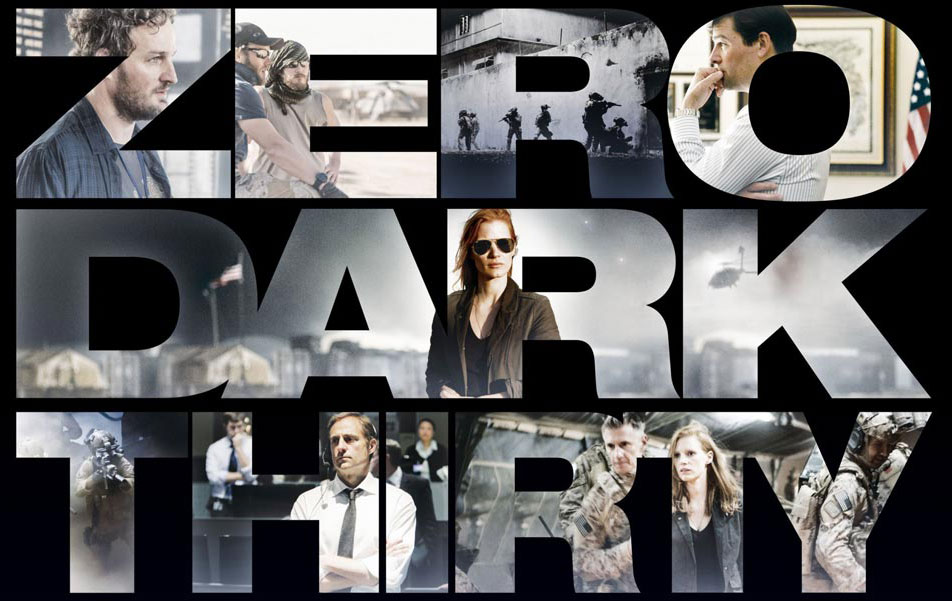
Zero Dark Thirty


Year: 2012
Director: Kathryn Bigelow
Cast: Jessica Chastain, Jason Clarke, Joel Edgerton, Mark Strong, Kyle Chandler, Jennifer Ehle, James Gandolfini

Before I begin my review….
Well, well, well. A week before the 85th Academy Awards and we make it to one of the more controversial nominees, Zero Dark Thirty.
The film which claims to give an accurate representation of Osama Bin Laden’s manhunt and death, has come under fire from the CIA and other sources depicted in the film.  It has been claimed by these sources that the film is not as accurate as what it proposes, but director, Kathryn Bigelow and writer, Mark Boal have come out defending their film. Boal quoted “It is a movie. I’ve been saying from the beginning that it is a movie. That shouldn’t be too confusing”.
I see why the CIA and other people feel the need to express what was and wasn’t completely accurate in the film, but what Zero Dark Thirty does is not unlike every other film which is based on real life events. There are certain things which are always added and exaggerated for dramatic effect so the film remains entertaining.
Many have believed that the controversy the film has created has hurt its chance at receiving any of the awards at this year’s Oscars. Personally, I think it may play a tiny part, but, as Boal said, it is a film and it is being judged at the awards as a film and not on its publicity.
Although I think Zero Dark Thirty is a very good film and it is one of the five films that really has a good chance of winning Best Picture, I am not convinced it will. I would love to see Kathryn Bigelow win her second Best Picture Oscar and I can’t help but feel that she is another director whom the academy have made a mistake leaving out of the nominations. So my final word on the matter is that it is another film I would love to see win, but I don’t think the odds are in its favour.
Then there is the amazingly versatile and brilliant Jessica Chastain who is up for Best Performance by an Actress. She is very deserving of her nomination and is also deserving of her first Oscar. However, it is a tough race to the finish with her and Jennifer Lawrence neck and neck. Chastain’s performance is a lot more subtle than Lawrence’s .Personally, I would love to give Chastain an award just for the person she comes across as every time you see her on TV. She seems incredibly down to earth and so appreciative of everything that happens to her. She has sparkle in her and she just makes you want to sit down with her and have a conversation that leaves you both in hysterics.

Review
Don’t be fooled, Zero Dark Thirty is not Kathryn Bigelow’s last film, The Hurt Locker.
Although the two may look similar on the outside due to their locations and war themes, Zero Dark Thirty storyline flows through the film and gains momentum as it progresses. It is a thrilling ride and proves that even if the world knows the end of the story, that isn’t an excuse for lack of suspense.
After September 11 2001, the CIA starts the greatest man hunt in history for the man behind it all, Osama Bin Laden. CIA agent, Maya (Jessica Chastain) is sent to Pakistan to interrogate detainees in the quest to track down Bin Laden’s whereabouts. She obsessively searches for the man and his closest confiders for eight years before there is finally a breakthrough that she believes leads directly to the place where Bin Laden has been hiding all these years.
Films based on true events are often expected not to be suspenseful or thrilling as such because you know how they are going to finish. However, Zero Dark Thirty does not fit into this category. The film is incredibly tense at times and the final 20 minutes is nail-biting. Bigelow has the uncanny ability to not rely on a musical score to be the provider of suspense and create tension by letting the audience know early on that high pressure moments can come from nothing. She therefore keeps the audience on the edge of their seats because they are not sure what is going to happen next.
The script is very in depth and you feel as if you can’t miss a word of what the characters are saying because you might miss something. This is another amazing thing for a film which is over 2 and ½ hours long. You would think with that length that there would be lots of moments of nothing, but writer, Marl Boal has packed nearly eight years into this film and there is plenty to go through. Every scene means something for the film, whether it be in the progression of the story or in character development and growth.
The editing is brilliantly done and at some points, the cinematography can be really quite beautiful. The vision of the helicopters in the night sky over Pakistan is breath taking.
Jessica Chastain is a wonderful leading lady. She exhibits perfect growth in her character by going from an almost meek girl on her first days of interrogation, to being emotionally and mentally exhausted and then completely gaining momentum to take control of the whole project. She is relatable and the audience builds a relationship with her. You want her to succeed and care about her.
Mark Strong and Kyle Chandler also give very good performances and create great support for Chastain.
Kathryn Bigelow has done it again with Zero Dark Thirty by providing us with another fantastic movie that has the ability to give you the unfortunate outcome of a sore back or neck from unbelievable tension.

9/10


References
New York Daily News
The Telegraph

Wednesday, February 13, 2013

Lincoln (2012)


Year: 2012
Director: Steven Spielberg
Cast: Daniel Day-Lewis, Sally Field, Tommy Lee Jones, David Strathairn, Joseph Gordon-Levitt

Before I begin my review….

                It’s getting close! Less than two weeks to go till the 85th Academy Awards! The countdown is on and I am getting to the point where I feel as though I can start to make informed predictions about who I believe will take home the big awards.

So we have our sixth nominated film to be reviewed, Lincoln. I think everyone, including me, knows that this film has at least one guaranteed Oscar.

Lincoln is nominated for a massive 12 Academy Awards. I can tell you with complete certainty that it will not be walking away with all 12. It is nominated for Best Picture as well as Best Director for Steven Spielberg. I’m not completely convinced that this is the year’s Best Picture winner. Following all the other award nights, I have an idea which film may be having its name engraved in one of the pillars lining the Dolby Theatre (once the Kodak Theatre)stairs, and Lincoln will be a major surprise if it leapfrogs over that film to take the big one.

However, Spielberg wouldn’t be completely out of line if he let it be known that he is preparing his acceptance speech. We all know he is a brilliant director, he has exhibited this numerous times. Lincoln once again exhibits how brilliant a director he really is. I believe he is the front runner in this category.

Tommy Lee Jones took home the Screen Actor’s Guild award for Best Supporting Actor and he is very deserving. However, he does have tough competition from Christoph Waltz. My personal opinion is that Waltz has just that little bit more than Jones and should be taking home the award. The Best Supporting Actor category is a tough category this year, there have been some fantastic performances this year.

Poor Sally Field (if you can say that, she’s had a pretty damn good career thus far). Anyone who is nominated for Best Supporting Actress this year is pretty much ruled out of the equation with Anne Hathaway the front runner. If Hathaway didn’t give the performance she had in Les Miserables, I believe Field would have been the front runner instead.

And then…we have Daniel Day-Lewis. Yes he is brilliant and yes, he will win his third Academy Award. Now this is a big thing. There are only five people who have won three acting Oscars in history, including Katharine Hepburn who has actually won four. It looks like Day-Lewis will be the sixth to join this coveted group.

Review

There is no doubt the Steven Spielberg is a great director. There is no doubt that Daniel Day-Lewis is an amazing actor. So there was really no doubt about whether Lincoln was going to be a success.

Lincoln is a film which is very well made and acted, but the fact remains, it is a film which will mean more to you if you are American. It is a great history lesson for those who only know the basics about Abraham Lincoln and the American Civil War, but there is a lack of emotion which you really want to feel for this great man.

Lincoln focuses primarily on Abraham Lincoln’s (Daniel Day-Lewis) final presidential years when he was instrumental in abolishing slavery. The passing of the amendment in the House of Representatives is covered in depth and shows what went on behind closed doors in order to make sure the outcome that Lincoln strived for was achieved. Away from politics, Lincoln also shows how strained his private life was during these years. His wife, Mary Todd Lincoln (Sally Field) struggles with their middle son’s death years before and their oldest son, Robert (Joseph Gordon-Levitt) struggles with trying to win his father’s affection and at the same time, become his own person.

Spielberg once again proves that he is an amazing story teller. He goes through the passing of the amendment in such detail that if you didn’t know much about Lincoln and the civil war before, you will feel as if you know everything when you leave the cinema. He does go through it in such detail that it can make the film a bit slow and also make it a tad boring in certain parts. You can understand why Spielberg has tried to include all this as he wants you to exactly know step by step how and why this amendment was passed. It is part of Spielberg’s job as a storyteller to entertain as well as inform, and he ensures he gives you the best history lesson he possibly can.

The main thing missing from Lincoln is the emotion in the film. You come out of the film thinking about how you have just seen a good film, but you are not over-whelmed in the way you are when you have seen a great film. There are so many great things about Lincoln, but it lacks the ‘wow’ factor and the ability to make the audience connect on an emotional level. It is not for lack of wanting or trying either. Lincoln is such a heroic historical figure that you want nothing more than to cry at his successes and failures. however, thi

However, Americans may have a greater emotional connection to this film as it is part of their history and it is a film which they will be able to relate to. For those who are not American may not have this emotional connection for this reason.

Don’t be alarmed, there is plenty to marvel at in this film. Visually it is a brilliant recreation of Civil War torn America. There is some beautiful cinematography, such as the depiction of Lincoln’s dream and Lincoln’s final speech.

Yet, it is the acting in Lincoln that truly makes the film. It is impossible to see anyone ever playing Abraham Lincoln again and being quite as convincing as Daniel Day-Lewis. Day-Lewis, who is known for becoming his characters on and off screen when making a movie, is the great man. Lincoln is surely looking down from Heaven and smiling on Day-Lewis. He does him so much justice and from what we know about Lincoln that has been carried down through the years, he is the absolute embodiment of him.

Sally Field is also incredible. Her performance is so heartfelt and shows a wife and mother who has given everything to her family.

Tommy Lee Jones is also brilliant as Thaddeus Stevens. It’s a strong performance and one with so much charisma.

Joseph Gordon-Levitt is not on screen for a tremendous amount of time, but for the time which he is, he is very good. He has one particular scene with Day-Lewis when he shows that he has it in him to become one of the greats in the years to come.

Lincoln is a wonderful history lesson, but misses that emotional chord that would make it a great.

7.5/10